State.Not Situation
Why your body decides what a moment means before you do
Get the book
List price €28.90 before VAT, with delivery from Amazon in Germany. Other stores and countries set their own prices and delivery.
In Luxembourg, soon at Alinéa.
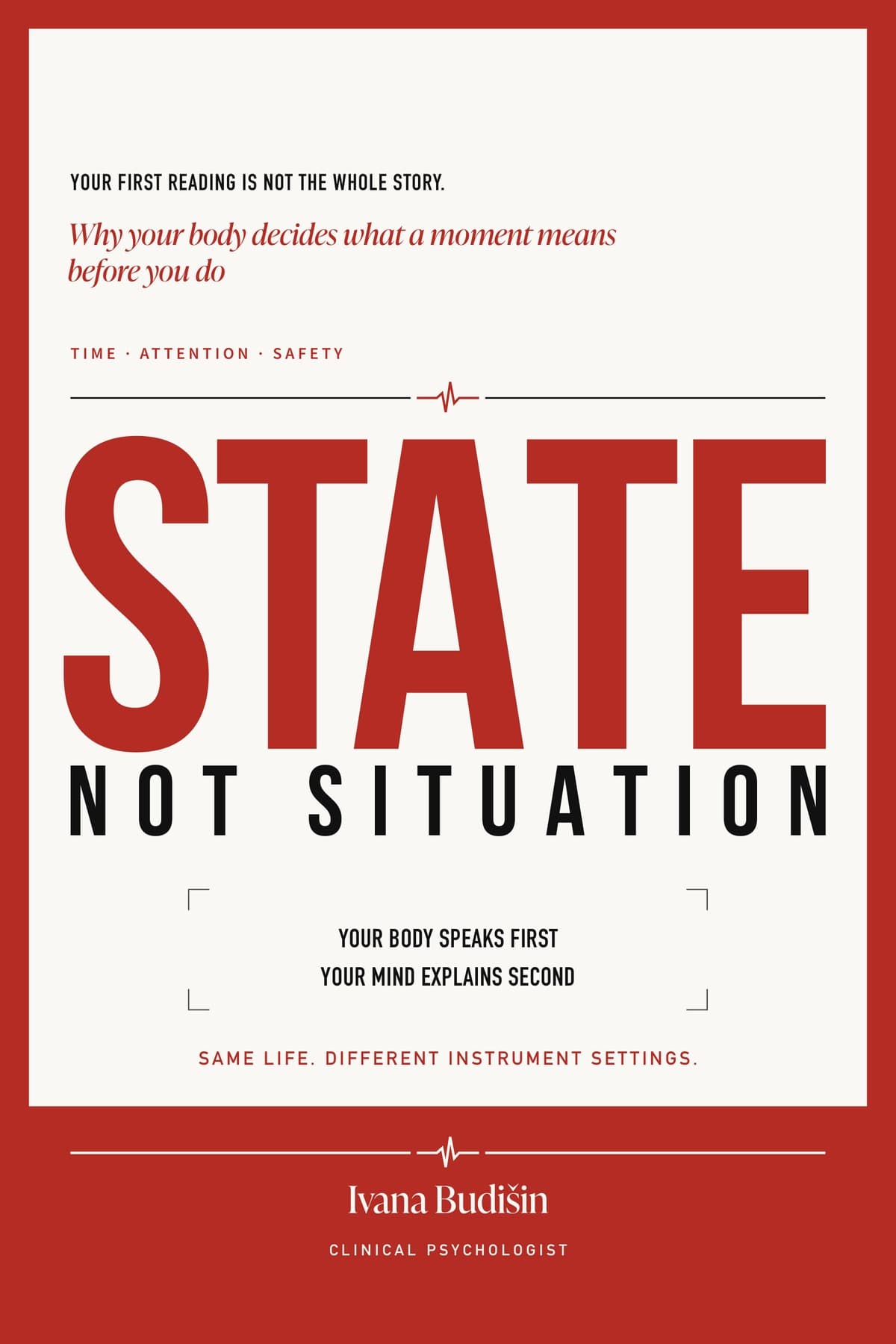
Your first reading is not the whole story.
by Ivana Budišin
Clinical psychologist, Luxembourg
With a foreword by Dr Kristina Herber
Published 15 October 2026
Read an extractThe first misreading
4
The body is a sensor before it is a narrator.
You may not be reacting to the world.
You may be reacting to your state.
We usually treat these moments as information about life: the person, the task, the relationship, the day.
But the first reading is often not the whole story.
Before the mind explains, the body has already voted. Sleep pressure, hunger, timing, attention, threat detection, memory, and prediction quietly shape what feels true.
Then the mind arrives second and gives that feeling a reason.
Try something right now
7
Whatever you are feeling as you read this sentence.
- Check your jaw.
- Check your breath.
- Check your shoulders.
What you found is a reading.
Time. Attention. Safety.
What came before this moment? Sleep, meals, caffeine, recovery, the hour.
What keeps pulling me back? A message, a thought, a cue, an unfinished task.
What seems at stake? What have I observed, what am I assuming, and does anything need action?
7
They are not brain regions or neural pathways.
They are a sorting tool, a way to ask three questions when everything feels wrong at once.
16 cases. Three readings. One question: state or situation?
4
The same day, five readings
- 06:38
- A heaviness arrives before the day does.
- 09:12
- A two-line email reads like a judgement.
- 14:23
- Five neutral words tighten a jaw.
- 17:45
- An unanswered message starts charging cognitive rent.
- 22:47
- Two letters and a full stop feel hostile.
The body speaks first. The mind explains second.
7
Evidence
High
Replicated or robust evidence.
Medium
Suggestive evidence with meaningful uncertainty.
Low
Plausible hypothesis or emerging evidence.
These markers exist because the book’s own risk is the same risk it describes.
Foreword
Our first interpretation is not necessarily wrong. But it does not have to be our last.
A book that cautions us against confusing a persuasive interpretation with certainty also applies scrutiny to its own interpretations.
Before the chapters
The pilot
It is less interested in teaching you to trust your instincts than in showing you what, exactly, you are trusting.
On the evening of 16 July 1999, a small single engine plane took off from New Jersey. It was heading for Martha’s Vineyard. The pilot was experienced enough to be confident and new enough to be wrong about what that confidence meant. He had about 300 hours in the air. He had not finished the training that would qualify him to fly using only his instruments.
The sky was clear when he departed so he concluded that he did not need instruments. By the time he reached the coast, a haze had settled over the water. The mist, the one that erases the line between sea and sky so gradually that you do not notice the horizon is gone until you look for it and it is not there. Over land there are lights below. You see roads, buildings, a geometry that tells your eyes which way is down. Over open water at night, with haze sitting on the surface like a second darkness, there is nothing. The world outside the cockpit becomes a uniform grey in every direction. Up looks like down. A gentle turn feels like level flight. A slow descent feels like holding steady.
Sixteen names.
A name for it
- 00Narrating modePage 16
- 01MisattributionPage 24
- 02The smoke detector principlePage 36
- 03Variable rewardPage 50
- 04Wanting and likingPage 66
- 05Wake Maintenance ZonePage 80
- 06Default mode networkPage 96
- 07Evaluation threatPage 107
- 08RuminationPage 126
- 09Demand–withdrawPage 141
- 10MetacognitionPage 158
- 11StackingPage 176
- 12Prediction errorPage 196
- 13CalibrationPage 210
- 14Warm panelPage 222
- 15ForecastPage 239
Each name closes its chapter. The page number is where the entry sits.
A name for it / 01
Misattribution
Giving a feeling the wrong cause. The body produces the feeling. The mind looks for a reason and takes the nearest one. The feeling is real. The reason is a guess.
How it shows up
- Tiredness that arrives as a question about your career.
- Coffee on an empty stomach that arrives as worry about an email.
- Low blood sugar that arrives as doubt about a relationship.
Try it
Before acting on a confident judgement, name one fact that could change your mind.
Page 24

Ivana Budišin
Ivana Budišin is a clinical psychologist living and working in Luxembourg. State. Not Situation. is her first book.
For anyone who has ever been certain about what a situation meant, then discovered that something else was happening. And for readers interested in the psychology of how we notice, interpret and revise the world around us.
Page 238
Is this the situation? Or is this their state?
Same life. Different instrument settings.
Get the book
List price €28.90 before VAT, with delivery from Amazon in Germany. Other stores and countries set their own prices and delivery.
In Luxembourg, soon at Alinéa.
Beyond the page
There is more than one way in.
Try a short scene, come to a public event, or invite Ivana to speak with your group. You don’t need to have read the book.
Try a short scene
An ordinary moment. A different way to look at it. Explore three short examples inspired by the book.
Come to an event
Find public talks, readings and workshops with Ivana, as dates are announced.
Invite Ivana
Explore talks, team sessions and workshops for your organisation, venue or group.
The STATE companion app is in development.About the app